
Microplastic Transport in Groundwater: A Review of Pore-Scale Transport Mechanisms

Updated: Aug 21
Microplastics are plastic polymer particles ranging from approximately 1 μm to 5 mm in size. The most common polymer types include polyethylene (PE), polypropylene (PP), polystyrene (PS), polyvinyl chloride (PVC), and polyethylene terephthalate (PET) (Huang et al., 2021). These particles are primarily generated through the fragmentation and degradation of larger plastic debris exposed to physical, chemical, and biological weathering processes (Walker & Fequet, 2023).
To date, microplastics have been detected in nearly every environmental compartment, including surface waters, oceans, sediments, soils, and the atmosphere (Bothma et al., 2024; Lin et al., 2026; Reynoso-Cruces et al., 2026; Yang & Tang, 2025). More recently, their occurrence has also been confirmed in aquifers and groundwater systems across different regions of the world (Hua et al., 2026; Rodríguez-Alcántara et al., 2024; Samandra et al., 2026; Sruthy et al., 2025; Zheng et al., 2026), with reported concentrations ranging from 14 to 1,889 particles L⁻¹. Concentrations vary considerably depending on analytical methodology.
Groundwater contamination by microplastics has become an increasing concern because groundwater supplies drinking water to nearly two billion people worldwide (Re, 2019). Moreover, experimental studies have associated exposure to microplastics with adverse health effects, including inflammation, oxidative stress, apoptosis, and metabolic disorders (Sadique et al., 2025). Microplastics can also act as carriers, under certain environmental conditions, of hazardous substances such as heavy metals, pharmaceutical residues, and persistent organic pollutants, increasing risks to both ecosystems and human health (Ali et al., 2025).
After being deposited onto soils through human activities, microplastics may infiltrate the subsurface and eventually reach groundwater. Their mobility depends on a combination of particle characteristics (e.g., size, density, shape, surface properties, and polymer type), porous media properties (e.g., grain size, pore structure, and mineral composition), and hydrochemical conditions (e.g., pH, temperature, ionic strength, and water chemistry) (Cai et al., 2026; Dong et al., 2018; Kaya et al., 2026; Wu et al., 2020).
The growing evidence of microplastic occurrence in groundwater has stimulated research into the mechanisms governing their transport through porous media. These mechanisms include advection, hydrodynamic dispersion, straining, filtration, interception, attachment, heteroaggregation, Brownian diffusion, electrostatic interactions, and gravitational settling. Nevertheless, considerable uncertainties remain regarding the relative importance of these processes and their interactions at the pore scale.
Understanding pore-scale transport mechanisms is therefore essential for predicting the environmental fate of microplastics and developing effective monitoring and remediation strategies. This review summarizes the current knowledge of pore-scale transport mechanisms and discusses the numerical models developed to describe microplastic migration through porous media and groundwater systems.
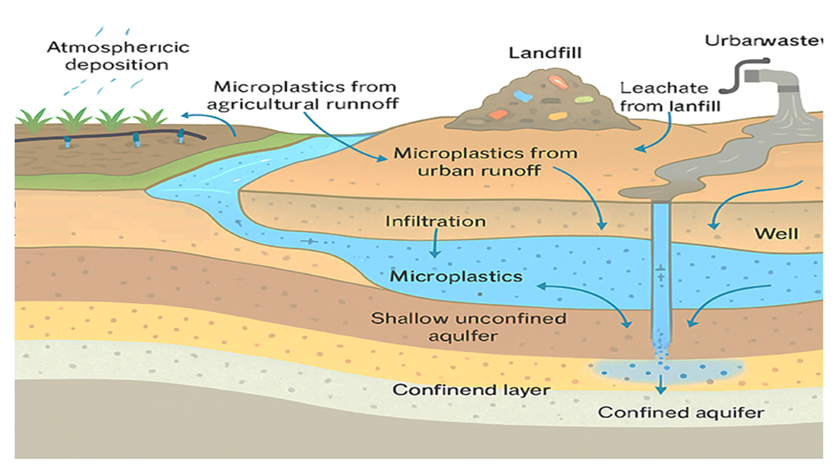
Main transport and retention mechanisms of Microplastics in the subsurface
The mobility of microplastics in subsurface environments is too complex to be adequately described solely by the classical advection-dispersion equations with time-invariant transport coefficients (Botari & Bernardo, 2012). Instead, the transport and retention of microplastics are governed by the interplay of multiple physical, physicochemical, and biological processes occurring within porous media.
Microplastic mobility is primarily controlled by their intrinsic properties, including particle size, shape, density, surface charge, hydrophobicity, and polymer type. Likewise, porous media characteristics, such as grain size, surface charge, porosity, organic matter content, and the presence of preferential flow paths (e.g., macropores), strongly influence particle transport and retention. In addition, hydraulic and hydrochemical conditions including flow velocity, pH, ionic strength, and salinity modify the interactions between microplastics and solid surfaces, thereby affecting their migration through porous media.
Based on current scientific evidence, the mechanisms governing microplastic transport in subsurface environments can be classified into three major categories: physical, physicochemical, and biological mechanisms.
Physical mechanisms:
- Advection. Advection refers to the transport of microplastics by the bulk movement of groundwater through porous media. This process is primarily controlled by groundwater flow velocity, hydraulic gradients, and the physical properties of both the fluid and the porous medium. Advection is considered the dominant transport mechanism for mobile microplastic particles and acts in conjunction with dispersion and retention processes (Sun & Zhang, 2020).
- Dispersion. Hydrodynamic dispersion results from spatial variations in flow velocities within pore networks, causing microplastics to spread beyond the average groundwater flow path. The magnitude of dispersion depends on transport distance, pore-scale heterogeneity, and mean flow velocity, making it a scale-dependent process (Sun & Zhang, 2020).
- Straining. Straining is a physical retention mechanism that occurs when microplastic particles become trapped within pore throats smaller than their effective size. This mechanism is particularly important for large, elongated, irregularly shaped, or hydrophobic particles. Biofilm formation may further enhance straining by reducing pore space and increasing the likelihood of particle entrapment (Ramezanpour et al., 2022; Singer et al., 2025)
- Gravitational settling. Gravitational settling occurs when the density of microplastic particles exceeds that of the surrounding fluid, causing them to settle under gravity and accumulate on porous media surfaces. This mechanism becomes increasingly important for high-density polymers under low-flow conditions (Cao et al., 2023).
Physicochemical mechanisms:
- Heteroaggregation. Microplastics can interact with natural colloids and other constituents present in porous media through electrostatic attraction, van der Waals forces, hydrophobic interactions, and surface complexation. These interactions promote the formation of larger aggregates that are more readily retained within the porous matrix. Heteroaggregation has been reported in the presence of humic substances, organic colloids, iron and aluminum oxides, and multivalent cations such as Ca²⁺, which act as bridging agents and facilitate aggregate formation (Wang et al., 2022)
- Attachment. Attachment occurs when microplastics adhere to porous media surfaces through physicochemical interactions. Environmental conditions such as high ionic strength, elevated salinity, or the presence of positively charged materials reduce electrostatic repulsion and enhance particle deposition, thereby decreasing microplastic mobility. Likewise, amendments such as Fe₃O₄-biochar provide additional attachment sites and further promote particle retention (Chanda & Bathi, 2026; Wang et al., 2022).
- Electrostatic interactions. Electrostatic attraction and repulsion between microplastics and porous media surfaces strongly control particle transport and retention. These interactions are governed by pH, ionic strength, salinity, and zeta potential. When attractive forces dominate, microplastic deposition is enhanced, whereas stronger electrostatic repulsion promotes particle mobility (Chanda & Bathi, 2026).
Biological mechanisms:
Microbial colonization and bioturbation represent key biological processes altering microplastic mobility. The formation of biofilms on plastic surfaces (the "plastisphere") changes the particles' effective size, density, and surface charge, typically increasing attachment efficiency or enhancing physical straining due to pore-throat restriction (Singer et al., 2025). Conversely, bioturbation by soil macroorganisms can disrupt porous media packing, creating preferential macropore pathways that facilitate the rapid downward migration of microplastics toward shallow aquifers.

Pore-Scale Models of Microplastic transport in groundwater
Pore-scale models provide a mechanistic representation of microplastic transport by explicitly simulating particle migration through individual pore spaces. Unlike continuum-scale approaches, these models resolve pore geometry and account for the complex interactions between groundwater flow, porous media surfaces, and microplastic particles. Consequently, they can reproduce transport and retention mechanisms such as attachment, detachment, straining, bridging, and pore clogging with a high level of detail.
Because microplastic transport is strongly influenced by particle characteristics (e.g., size, shape, density, and polymer type) as well as pore-scale heterogeneity, experimental observations often exhibit complex behaviors, including early breakthrough, tailing, and multimodal breakthrough curves. Capturing these phenomena requires models that explicitly incorporate the physical and physicochemical interactions governing particle retention, remobilization, and preferential flow pathways, rather than relying solely on conventional advection-dispersion equations with constant attachment coefficients (Botari & Bernardo, 2012).
To address these transport processes, several pore-scale models have been developed. The following table reviews some of the most recent models, together with the predominant transport mechanisms they incorporate.
Table 1. Summarizes the main pore-scale modeling approaches that have been developed to investigate microplastic transport through porous media.
Reference | Modelling approach | Particle type | Process considered | Main findings |
Dispersion-drag force coupled model (DDM) | The model accounts for the specific types, size and density | Drag force Dispersion Advection Particle Tracking
| The introduction of the dispersion coefficient (DL) facilitates the microplastic infiltration from soil layers into the saturated aquifer. Higher DL increases the maximum particle velocities increasing the migration amount of MPs within the saturatedaquifer. Size and density of MPs affect their migration. | |
Adsorbed Particle Tracking Model (APTM) | 4 µm PS beads | Adsorption Hydrodynamic drag Dielectrophoretic force Brownian motion at the microscale | Variations in surface charge and polarity promote the attachment of particles to pore walls, increasing adsorption at pore boundaries. Higher porosity leads to lower retention by reducing physical and electrostatic trapping mechanisms. Higher temperatures promotemicroplasticadsorption by increasing particle diffusion,Brownian motion and collisions with pore walls.Increasing flow velocity enhances hydrodynamic drag, thereby reducing the relative contribution of Brownian motion anddielectrophoreticforces to particle transport and retention. | |
Multi-scale modeling approach combining Pore Network Modeling (PNM), COMSOL pore-scale flow simulation, DLVO theory, Colloid Filtration Theory (CFT), and HYDRUS-1D | Polypropylene (PP), Polyethylene (PE), Polystyrene (PS), Polyethylene terephthalate (PET), and PS microspheres (0.1–2.0 μm) | Advection Dispersion Filtration Attachment Pore-scale flow Temperature and salinity effects | MPs transport strongly depends on particle size, pore structure, temperature and salinity; heavy rainfall can accelerate migration toward groundwater. | |
Euler-Lagrange (EL) pore-scale model implemented in OpenFOAM | Nanoparticles (30–150 nm) | Advection Diffusion Brownian motion Drag Buoyancy DLVO interactions Deposition | Deposition was mainly controlled by Brownian motion. Higher temperature increased retention, while higher flow velocity and larger particle size reduced deposition. Increased ionic strength enhanced deposition by compressing the electric double layer. |
Conclusions
Microplastic transport in porous media is governed by a complex interplay of physical, physicochemical, and biological processes that determine particle retention, remobilization, and migration through subsurface environments. Because these mechanisms operate at the pore scale, understanding particle–fluid–solid interactions is essential for accurately predicting the fate of microplastics in groundwater systems.
Despite the growing evidence of microplastic contamination in aquifers worldwide, significant challenges remain in detecting, characterizing, and monitoring these particles in subsurface environments. The limited accessibility of groundwater systems, together with the lack of standardized sampling protocols and the high cost of current analytical techniques, continue to hinder large-scale assessments.
Laboratory experiments, particularly column transport studies, remain fundamental for quantifying key transport parameters such as attachment, detachment, straining, and dispersion. These experimental observations provide the foundation for developing and validating pore-scale and continuum-scale transport models.
Although pore-scale numerical models are computationally demanding, they provide an unparalleled mechanistic understanding of the processes controlling microplastic transport. Future research should focus on integrating experimental observations, pore-scale simulations, and continuum-scale models to improve predictions of microplastic migration under field conditions.
A better understanding of pore-scale transport mechanisms will be essential for assessing the long-term fate of microplastics in groundwater systems, supporting risk assessment, and developing effective monitoring and remediation strategies to protect one of the world's most important freshwater resources.
By Ángela Sofía
MSc in Environmental Engineering.
Department of Civil and Environmental Engineering (DECA), Universitat Politècnica de Catalunya (UPC) Groundwater Hydrology Group (UPC). Barcelona, Spain


Comments